
From Manila to Texas: A Friendship Made by Hand
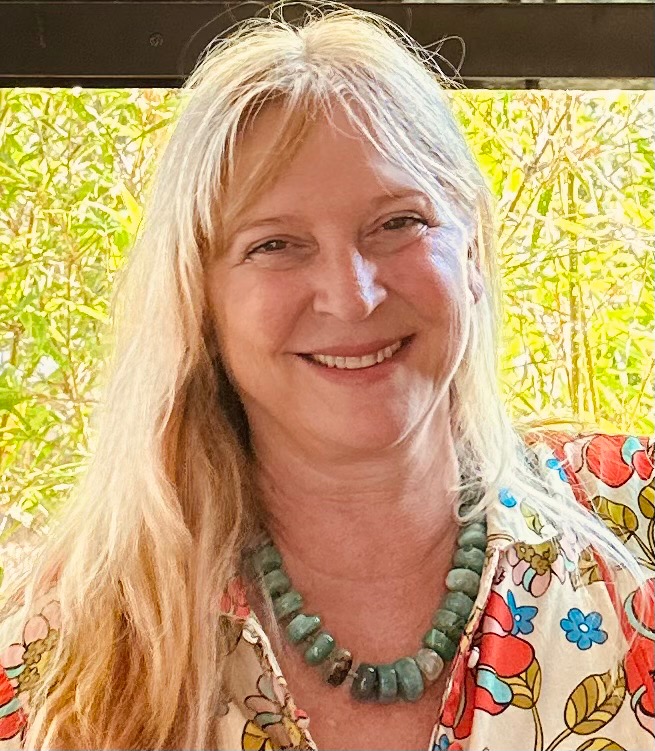

When Jo Anne Carceller Kessler arrived in Texas from the Philippines, one of the first things she asked me was a perfectly reasonable question:
“Why did you invite me?”
I answered, “Why did you come?”
Neither of us had a particularly good answer.
The answer began years earlier and thousands of miles away, when two strangers met at an art show in Manila and found themselves standing in front of the same handmade towels, pausing for reasons neither of us could yet name. We started talking.
Jo Anne and I quickly discovered a shared fascination with things made by hand – not only because they are beautiful, but because of the people, materials, traditions, and stories carried inside them. Jo Anne is the daughter of Emily Campos, who together founded Touch of Craft in the Philippines in 1986. Built around handcrafted accessories and decorative pieces, the company also created opportunities for women artisans. After her mother’s death, Jo Anne stepped into a new chapter of the business, carrying her mother’s legacy forward through Touch of Craft Legacy. At the time, I was building something of my own in Texas. Flint & Flowers, our small luxury campground in the Texas Hill Country, was taking shape among limestone, live oaks, cedar, and wildflowers outside Johnson City. Later that day in Manila, I saw a small horse bench that stopped me in my tracks. I set out to find the artist. And then I saw her – Jo Anne, the towel lady.


I followed her down the hall and back into her booth, certain I had found the maker. That moment changed the direction of everything. Flint & Flowers had found its signature functional piece of art: Horses. Each one was given its own personality, its own colors and textiles inspired by the tent it would eventually inhabit. Six horses were made in the Philippines and traveled across the Pacific to take up residence in the Texas Hill Country. Then Jo Anne Herself Came to Texas. Jo Anne traveled from the Philippines to Texas, and suddenly I had the unexpected privilege of introducing someone to a place I know intimately. We began at home beneath the oaks, with breakfast on the deck at Harmony House – tacos, dogs underfoot, and conversation that moved easily between family, art, and work.

From there, we started our journey across Central Texas with my daughter Kaya, grandson Bodhi, and daughter-in-law Nadia, who helps guide the social and technical side of Flint & Flowers. Over the days that followed, we moved through towns, backroads, and gathering places across the Hill Country, meeting makers, looking at old buildings, and talking with people whose work is rooted in this landscape. We became students together, a Texa-centric anthropologist and a whimsical functional artisan from the Philippines. There was laughter. There were cowboy hats. And there was, beneath it all, a growing sense that we were circling the same question from different directions: What makes something worth keeping? We picked things up, turned them over, and looked underneath them. We talked about materials, construction, and intention. We compared what felt authentic to what felt produced, what felt rooted to what felt detached. What is beautiful? What is useful? What carries meaning beyond its function? And what, ultimately, do people choose to live with? Those conversations became more focused as the days went on. Jo Anne and I spoke about design and material language.
Nadia brought the operational and digital perspective of Flint & Flowers. With Lian, we discussed production, shipping, and the realities of moving handcrafted work between the Philippines and Texas. And slowly, something new began to take shape. Not a product line. Not a souvenir. A collaboration. We began imagining objects that would live in both worlds – practical, usable things made with care, shaped by the Texas Hill Country but created through the hands and traditions of Filipino artisans. The ideas are still forming. And that feels right. Because what we are building is not a collection. It is a relationship.


Two Mothers, Two Lineages. One of the most meaningful stops during Jo Anne’s visit was the Moore-Hancock House, the 1849 log cabin museum my mother has preserved. Jo Anne’s work with Touch of Craft is inseparable from the legacy she inherited from her mother, Emily Campos. She is not only continuing that work, but also deciding what it becomes next. My mother has spent a lifetime preserving history – especially the material traces of ordinary lives, and most importantly, the difficult truths of slave ownership in Texas. Standing there, it was impossible not to see the parallel.

Craft, memory, inheritance – none of it is static. All of it is carried forward by people deciding what to keep, what to change, and what to reveal.
And finally, Jo Anne saw Flint & Flowers. For the first time, she walked through a landscape she had previously known only through photographs and conversation – the limestone, the live oaks, the wildflowers, and the handmade details scattered quietly through the property. And she saw where her horses live. I remember watching her move through the space, not as a visitor, but as someone recognizing something she had created.
What began as a chance meeting in Manila had become something tangible: objects imagined together, shaped across continents, and now resting in a place neither of us could have fully pictured at the beginning. By the time she left Texas, we had notebooks full of sketches, questions, and half-formed ideas. But more importantly, we had a shared direction. We had begun to understand what we were actually doing. We were not simply exchanging objects between places. We were building a bridge between ways of seeing.
Which brings me back to the beginning. “Why did you invite me?” Jo Anne asked. “Why did you come?” I replied. Friendship, in this case, arrived before understanding. And collaboration arrived before definition. All we really recognized – across that first meeting in Manila, across the Pacific, and across the Hill Country – was a shared instinct: to notice what others pass by, to care about how things are made, and to ask, again and again, what they might become in the right hands.

Comments